C Program Round Robin Operating System
Increases the performance of Round Robin. Keywords: Operating Systems, Multi Tasking, Scheduling Algorithm, Time Quantum, Round Robin. Introduction Modern Operating Systems are moving towards multitasking environments which mainly depends on the CPU scheduling algorithm since the CPU is the most effective or essential part of the computer.
Round Robin is a where each process is assigned a fixed time slot in a cyclic way. • It is simple, easy to implement, and starvation-free as all processes get fair share of CPU. • One of the most commonly used technique in CPU scheduling as a core. • It is preemptive as processes are assigned CPU only for a fixed slice of time at most. • The disadvantage of it is more overhead of context switching.
The rebirth of african civilization pdf writer. ISBN: 161427858X Size: 23832 KB File formats: ePub, PDF, Kindle, Audiobook Status: AVAILABLE Last checked: 0 Minutes ago! * Unlimited Books, Magazines, & Comics wherever you are.
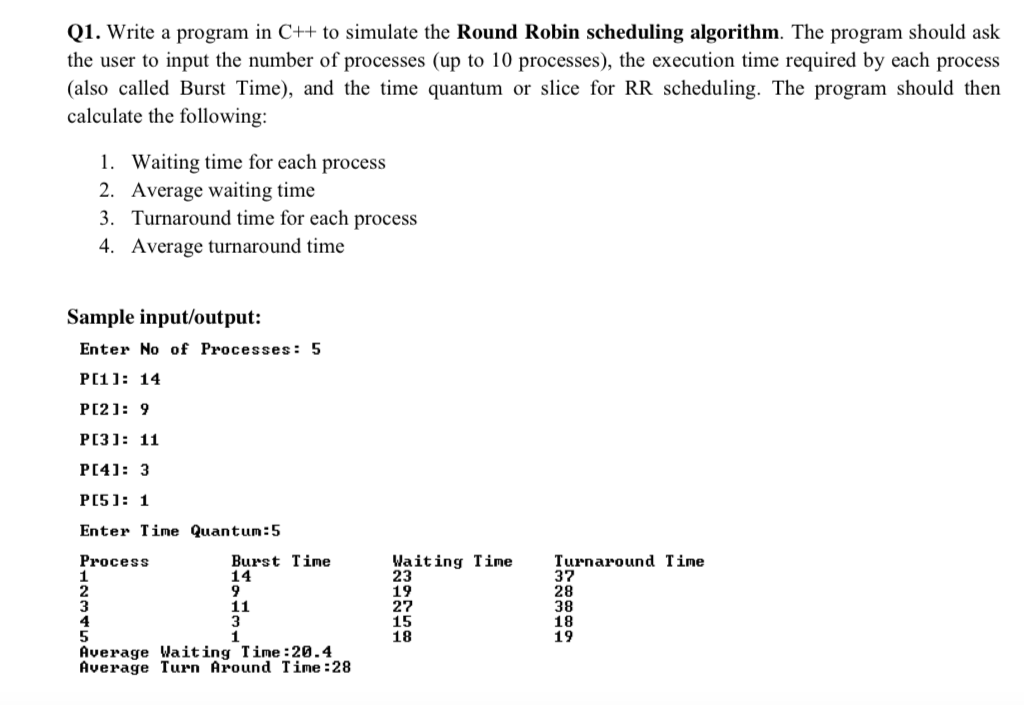
Illustration: How to compute below times in Round Robin using a program? • Completion Time: Time at which process completes its execution.
• Turn Around Time: Time Difference between completion time and arrival time. Turn Around Time = Completion Time – Arrival Time • Waiting Time(W.T): Time Difference between turn around time and burst time. Waiting Time = Turn Around Time – Burst Time In this post, we have assumed arrival times as 0, so turn around and completion times are same. The tricky part is to compute waiting times. Once waiting times are computed, turn around times can be quickly computed. Steps to find waiting times of all processes: 1- Create an array rem_bt[] to keep track of remaining burst time of processes. This array is initially a copy of bt[] (burst times array) 2- Create another array wt[] to store waiting times of processes.
Initialize this array as 0. 3- Initialize time: t = 0 4- Keep traversing the all processes while all processes are not done. Do following for i'th process if it is not done yet.
A- If rem_bt[i] > quantum (i) t = t + quantum (ii) bt_rem[i] -= quantum; c- Else // Last cycle for this process (i) t = t + bt_rem[i]; (ii) wt[i] = t - bt[i] (ii) bt_rem[i] = 0; // This process is over Once we have waiting times, we can compute turn around time tat[i] of a process as sum of waiting and burst times, i.e., wt[i] + bt[i] Below is implementation of above steps. Filter_none Output: Processes Burst time Waiting time Turn around time 1 10 13 23 2 5 10 15 3 8 13 21 Average waiting time = 12 Average turn around time = 19.6667 This article is contributed. If you like GeeksforGeeks and would like to contribute, you can also write an article using or mail your article to contribute@geeksforgeeks.org. See your article appearing on the GeeksforGeeks main page and help other Geeks. Please write comments if you find anything incorrect, or you want to share more information about the topic discussed above.
A Process Scheduler schedules different processes to be assigned to the CPU based on particular scheduling algorithms. There are six popular process scheduling algorithms which we are going to discuss in this chapter − • First-Come, First-Served (FCFS) Scheduling • Shortest-Job-Next (SJN) Scheduling • Priority Scheduling • Shortest Remaining Time • Round Robin(RR) Scheduling • Multiple-Level Queues Scheduling These algorithms are either non-preemptive or preemptive. Non-preemptive algorithms are designed so that once a process enters the running state, it cannot be preempted until it completes its allotted time, whereas the preemptive scheduling is based on priority where a scheduler may preempt a low priority running process anytime when a high priority process enters into a ready state. The mad monk stephen chow google. First Come First Serve (FCFS) • Jobs are executed on first come, first serve basis.

• It is a non-preemptive, pre-emptive scheduling algorithm. • Easy to understand and implement.
• Its implementation is based on FIFO queue. • Poor in performance as average wait time is high. Wait time of each process is as follows − Process Wait Time: Service Time - Arrival Time P0 0 - 0 = 0 P1 5 - 1 = 4 P2 8 - 2 = 6 P3 16 - 3 = 13 Average Wait Time: (0+4+6+13) / 4 = 5.75 Shortest Job Next (SJN) • This is also known as shortest job first, or SJF • This is a non-preemptive, pre-emptive scheduling algorithm. • Best approach to minimize waiting time. • Easy to implement in Batch systems where required CPU time is known in advance. • Impossible to implement in interactive systems where required CPU time is not known. • The processer should know in advance how much time process will take.
Process Arrival Time Execute Time Service Time P0 0 5 3 P1 1 3 0 P2 2 8 14 P3 3 6 8 Gantt Chart Wait time of each process is as follows − Process Wait Time: Service Time - Arrival Time P0 3 - 0 = 3 P1 0 P2 14 - 2 = 12 P3 8 - 3 = 5 Average Wait Time: (3+12+5) / 4 = 5 Priority Based Scheduling • Priority scheduling is a non-preemptive algorithm and one of the most common scheduling algorithms in batch systems. • Each process is assigned a priority. Process with highest priority is to be executed first and so on. • Processes with same priority are executed on first come first served basis. • Priority can be decided based on memory requirements, time requirements or any other resource requirement.